


Updated 16 November 2026.
Most drivers need only five or six car gadgets: a dashcam, a phone holder with charging, a jump starter, a tyre pressure gauge or compressor, an emergency escape tool and a Bluetooth adapter if the head unit cannot connect to a phone. Everything else depends on how you drive: mostly in town, on long motorway trips or in unfamiliar places.
We have grouped 17 useful car gadgets by the job they do, with notes on who really needs each one and what to look for when buying. We do not list prices, as they change quickly and each category has both budget and premium models.
What new cars already have, and what is worth adding
Before buying gadgets for your car, check the standard equipment. Since 7 July 2024, a new passenger car cannot be registered for the first time in the EU without several systems: intelligent speed assistance (ISA), driver drowsiness and attention warning (DDAW), an emergency stop signal, reversing detection and an event data recorder (EDR). This is required by Regulation (EU) 2019/2144. Tyre pressure monitoring (TPMS) has been mandatory on new passenger cars in the EU since 1 November 2014.
So the owner of a recent car imported from Europe usually does not need a fatigue monitor or parking sensors. For a car from the 2010s, inexpensive add-on devices provide the same functions.
Safety and evidence after an accident
1. Dashcam
The first gadget to fit if your car does not have one from the factory. The recording helps establish what happened in disputed situations after an accident and protects against staged collisions. In Ukraine dashcams are legal and their footage can be used as evidence: Article 251 of the Code of Administrative Offences explicitly mentions video recorded by the driver or witnesses, and Article 100 of the Civil Procedure Code treats video as electronic evidence. The court makes the final assessment.
What to look for: at least Full HD resolution, decent night recording, loop recording, an impact sensor (G-sensor) and, if needed, a second rear camera. Mount it behind the rear-view mirror: clause 31.4.7 of the Ukrainian Traffic Rules prohibits objects on the glass that restrict the driver's view.
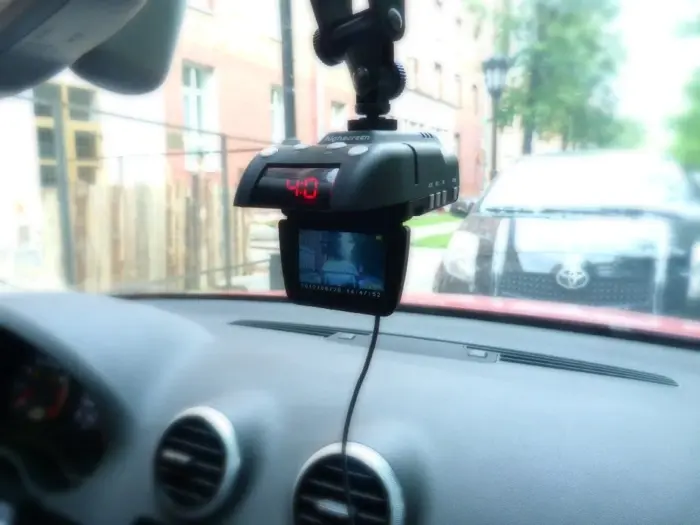
Dashcam with a radar detector. Photo: Sergey solom, Wikimedia Commons, CC BY-SA 3.0
2. Radar detector
Ukraine's current Code of Administrative Offences and Traffic Rules neither ban a passive radar detector nor set a fine for one: you are fined for speeding, not for the device. But it is less useful than it used to be. According to the patrol police, 426 automatic enforcement cameras have been operating in Ukraine since 20 August 2026, and officers also measure speed with TruCAM laser guns. Against laser, a radar detector usually alerts too late: the beam is narrow, and the signal appears only while your speed is already being measured.
A combined dashcam with a GPS database of cameras, which warns about fixed enforcement points, makes more sense. The surest way to avoid a UAH 340 fine for exceeding the limit by more than 20 km/h is simply to keep to it.
3. GPS tracker
A small beacon regularly sends the car's location to your smartphone. If the car is stolen, it can speed up the search considerably, as long as it is hidden where a thief will not find it in a minute. Look at battery life, SIM type and whether it alerts you when the car moves without your knowledge.
4. Driver fatigue monitor
The system analyses your steering, trip length and time of day, and some models track your eyes with a camera. When it detects signs of fatigue, it sounds an alert. New cars from the EU already have this function (DDAW) as standard, while older cars can use a separate dashboard device. It is useful for anyone who drives a lot at night, but it does not replace a break every 2–3 hours.
5. Blind spot mirrors
Small convex mirrors stick onto the side mirrors to show the zone that ordinary mirrors miss. It is the cheapest way to make lane changes safer if the car has no factory blind spot monitoring.
Navigation and connectivity
6. Phone holder
The most popular car gadget, since the phone has long replaced a separate sat nav. Ukraine's Traffic Rules (clause 2.9 «д») prohibit holding a phone while driving, with a fine of UAH 510 under Article 122(2) of the Code of Administrative Offences. So a holder lets you use navigation without breaking the rules.
Choose a mount that does not block your view or the airbags. Models with wireless (Qi) charging are handy on long trips, but the phone can overheat on them in summer, so an air-vent mount is the better choice.
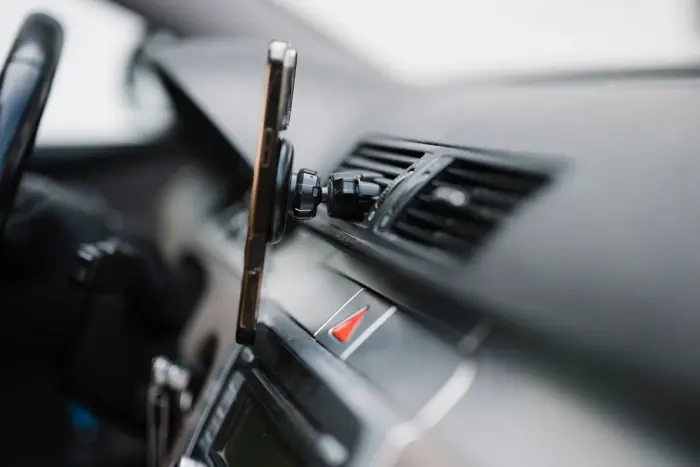
Smartphone in a dashboard holder. Photo: Shixart1985, Wikimedia Commons, CC BY 2.0
7. Sat nav
A dedicated GPS navigator is needed less often than before, but it still makes sense where there is no mobile signal, such as in the mountains or on remote roads. The alternative is to download offline maps to your phone before the trip, for example before setting off on car routes through the Carpathians.
8. Mobile Wi-Fi router
It shares internet from one SIM card with passengers, which is handy when several people in the car have tablets and laptops. For a driver alone, a phone hotspot is usually enough. Look for 4G support, battery capacity or USB power, and the option to connect an external antenna.
9. Speakerphone
It clips to the sun visor and pairs with your phone via Bluetooth, so you can talk without holding the phone, as the Traffic Rules require. Useful in cars without built-in hands-free.
10. Bluetooth adapter and wireless CarPlay/Android Auto
If the head unit cannot connect to a phone, a Bluetooth adapter plugs into the AUX or USB socket, and music from your phone plays through the car speakers. If the car supports only wired Apple CarPlay or Android Auto, USB adapters can make the connection wireless; expect a slight delay in sound and controls.
11. FM transmitter
An option for old head units without AUX or Bluetooth: the device plugs into the cigarette lighter socket and sends sound to a free FM frequency. Sound quality is lower than with a cable. Ukraine's communications regulator (NKEK) allows ultra-low-power FM transmitters (up to 50 nW) to be used without an individual permit.
Parking
12. Parking sensors
Ultrasonic sensors in the bumper beep faster as an obstacle gets closer. They are most useful in town, where you often park in tight spots. A rear kit with 4 sensors is the basic option; front sensors help on cars with a long bonnet.
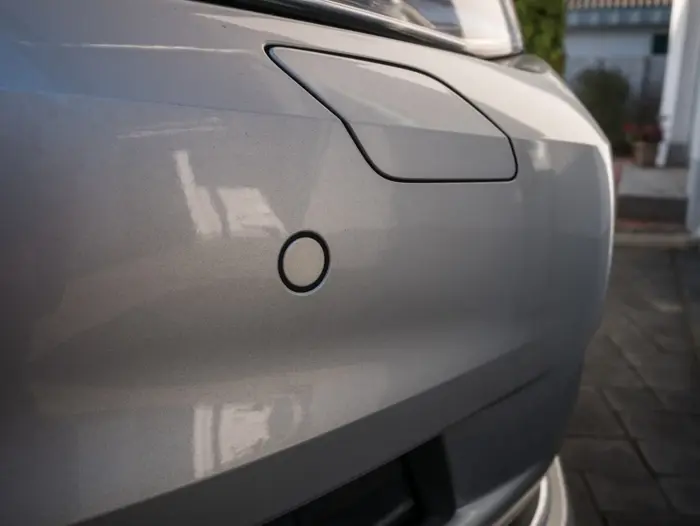
Parking sensor in a bumper. Photo: Basotxerri, Wikimedia Commons, CC BY-SA 4.0
13. Reversing camera
It complements parking sensors: sensors will not warn you about a pothole or a low post, but the camera shows them on the screen. There are wireless models and versions that display the image on the rear-view mirror or the factory screen. Check the viewing angle, low-light quality and trajectory guide lines.
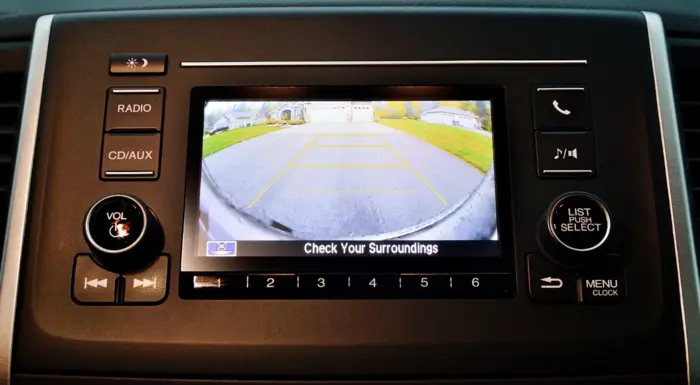
Reversing camera on the infotainment screen. Photo: Kelvin Eng, Wikimedia Commons, CC BY-SA 4.0
Emergencies and winter trips
14. Jump starter
A compact lithium battery pack that helps start the engine when the car battery has died in the cold. It saves you from looking for someone to give you a jump on the road, and most models also charge a phone. When choosing, match the peak current to the engine size (diesels need more) and look for reverse-polarity protection.
Manufacturers of lithium jump starters usually limit storage to roughly −20 to +50 °C. In summer, do not leave the device in the sun inside the car, and charge it at 0 to +40 °C. Exact limits are in your model's manual.
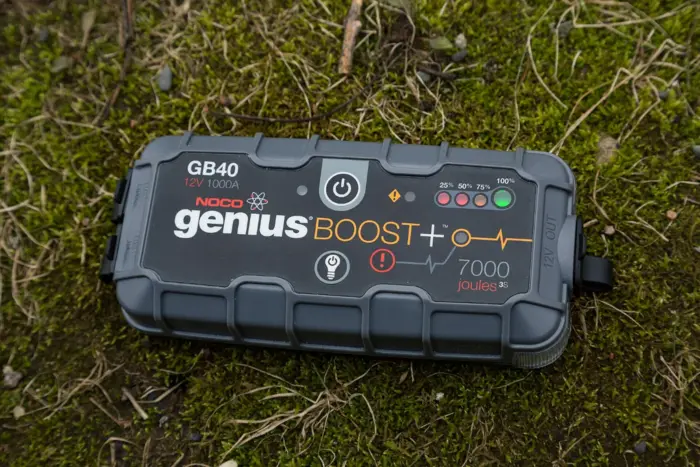
Lithium jump starter. Photo: Tony Webster, Wikimedia Commons, CC BY 2.0
15. Tyre pressure gauge and compressor
Tyre pressure affects braking, tyre wear and fuel consumption, and in winter it drops with the temperature. The correct value is on the manufacturer's placard (usually in the driver's door frame or on the fuel flap) and in the owner's manual; the number on the tyre sidewall is the maximum, not the recommended pressure. A separate digital gauge is more accurate than the one built into a cheap compressor, so it is worth having both.
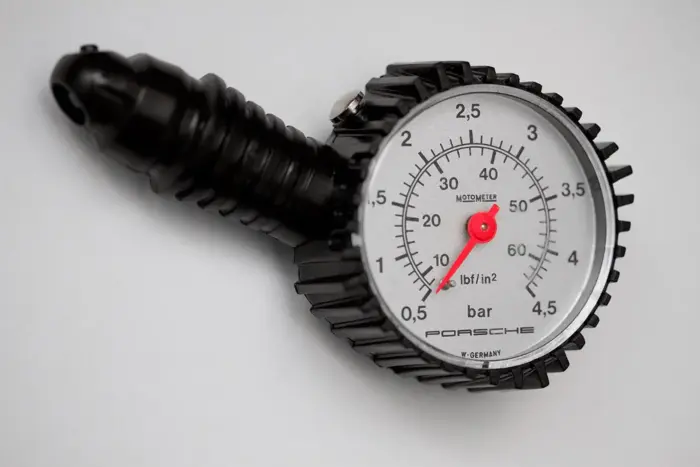
Tyre pressure gauge. Photo: Antti, Wikimedia Commons, CC BY 2.0
16. Emergency escape tool
A keyring or hammer with a window breaker and a seat belt cutter. Keep it within reach of the driver's seat, not in the boot. Bear in mind that such a tool breaks only tempered glass. The windscreen, and the side windows in many new cars, are laminated, and a window breaker will not get through them, as an AAA test showed. The glass type is marked in the corner of each window (TEMPERED or LAMINATED).
Comfort on the road
17. HUD projector
It shows your speed and navigation prompts on the windscreen or on a separate transparent screen, so you do not have to look away from the road. There are two types: units that connect to the OBD-II diagnostic port and show data from the on-board computer, and standalone GPS units that show only speed and time. If your car is under warranty, the second type is the safer choice. On some models the image is hard to see in bright sunlight, so check the brightness.
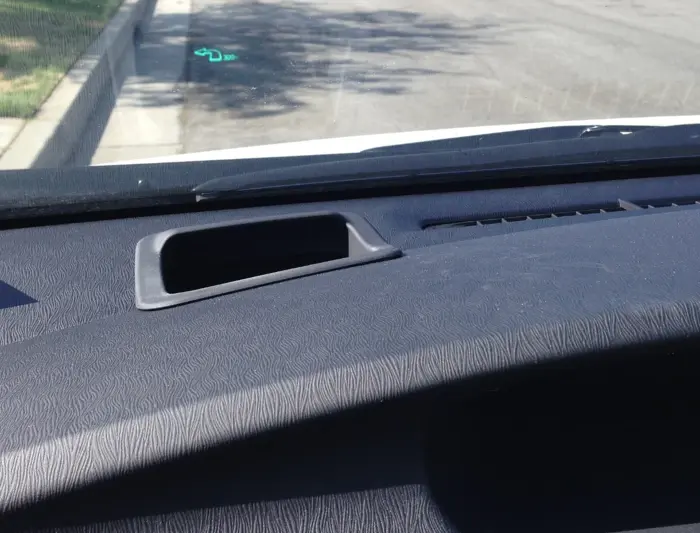
Head-up display on a Toyota Prius dashboard. Photo: Kowloonese, Wikimedia Commons, CC BY-SA 3.0
Comparison: which car gadgets suit whom
| Gadget | Problem it solves | Who needs it most | What to look for |
|---|---|---|---|
| Dashcam | evidence after an accident, protection from staged crashes | everyone | Full HD, night recording, G-sensor |
| Phone holder | navigation within the Traffic Rules | everyone | does not block the view, Qi charging |
| Jump starter | flat battery in winter | drivers who park outdoors | peak current, clamp protection |
| Pressure gauge and compressor | low pressure, tyre wear | everyone | accuracy, hose length |
| Emergency escape tool | getting out after a crash | everyone | belt cutter, easy reach |
| Parking sensors / camera | tight parking | city drivers | viewing angle, night quality |
| Bluetooth adapter | music and calls from the phone | owners of older cars | connector type, sound quality |
| GPS tracker | finding the car after theft | owners of expensive or frequently stolen cars | battery, alerts |
Gadgets for road trips
For a long trip, add a car fridge or cool bag, a 12/220 V inverter for a laptop, a multi-port USB-C charger and a torch to the basic kit. Download offline maps before you leave, as the signal drops in the mountains. If you are still choosing a car for the journey, see our pick of the best cars for travelling around Ukraine.
Gift ideas for a driver
The safest gifts are things everyone needs but rarely buys for themselves: a good dashcam, a lithium jump starter, a cordless compressor or a holder with wireless charging. A tech enthusiast will appreciate a HUD projector or a wireless CarPlay/Android Auto adapter, but first find out what the car already has so you do not give a duplicate of a factory feature.
FAQ
Which car gadgets are the most useful?
A dashcam, a phone holder, a jump starter, a tyre pressure gauge or compressor and an emergency escape tool. Almost every driver needs them, whatever the car.
Are radar detectors legal in Ukraine?
Yes. Ukraine's current Code of Administrative Offences and Traffic Rules do not ban a passive radar detector or set a fine for one. However, it is of little use against TruCAM laser guns, and fixed cameras are better tracked with a GPS database.
Can dashcam footage be used as evidence?
Yes. Article 251 of the Code of Administrative Offences explicitly mentions videos recorded by the driver and witnesses, and the Civil Procedure Code treats video as electronic evidence. Keep the original file and do not edit it.
Which gadgets should I take on a long trip?
A phone holder with charging, a jump starter, a compressor, offline maps, a 12/220 V inverter and a fridge or cool bag. Check your tyre pressure before you set off.
Does a rental car come with gadgets?
It depends on the model: modern cars usually have Bluetooth, USB and often CarPlay/Android Auto, parking sensors or a camera. You can bring your own phone holder or dashcam. If you plan to rent a car in Kyiv, ask about the exact equipment of the car when booking.
Conclusion
Buy gadgets for the trips you actually make, not from an «everything at once» list. First check what your car can already do, then add a basic safety kit: a dashcam, a phone holder, a jump starter, a pressure gauge and a window breaker. Set up anything that needs adjusting before you start driving.