


Parking rules in Ukraine cover more than choosing an empty space. They also determine when a driver may make a brief stop. A practical safety rule is simple: if your car blocks visibility, pedestrians, public transport, emergency access, or the movement of other vehicles, it is not a suitable place to stop.
These rules matter just as much when you drive a rental car. A parking violation can interrupt a trip and may require you to contact the rental company. This guide provides a practical overview with official sources. It does not replace road signs, road markings, or the decision of an authorised inspector in a specific situation.
Quick answer: distances to remember
Ukraine’s Traffic Rules set out the rules for stopping and parking. These are the key distances worth remembering.
| Location | Basic rule | Check as well |
|---|---|---|
| Pedestrian crossing | Do not stop on a crossing or within 10 m of it on either side, except for cases expressly allowed by the Traffic Rules. | Signs, road markings and pedestrian visibility. |
| Intersection without a crossing | Do not stop at the intersection or within 10 m of the edge of the intersecting carriageway. | The Traffic Rules contain exceptions for certain intersection layouts. |
| Public-transport stop | Do not stop within 30 m of the marked stop. | If there is no sign, check the stop bay or road markings. |
| Railway crossing | For parking, stay at least 50 m away; stopping on the crossing itself is prohibited. | Do not confuse parking with a forced stop caused by traffic or safety. |
| Roadworks area | Do not stop within 10 m. | Temporary signs and barriers may impose stricter restrictions. |
| Narrow road | Do not stop if less than 3 m remains for other vehicles to pass. | Consider emergency vehicles as well as passenger cars. |
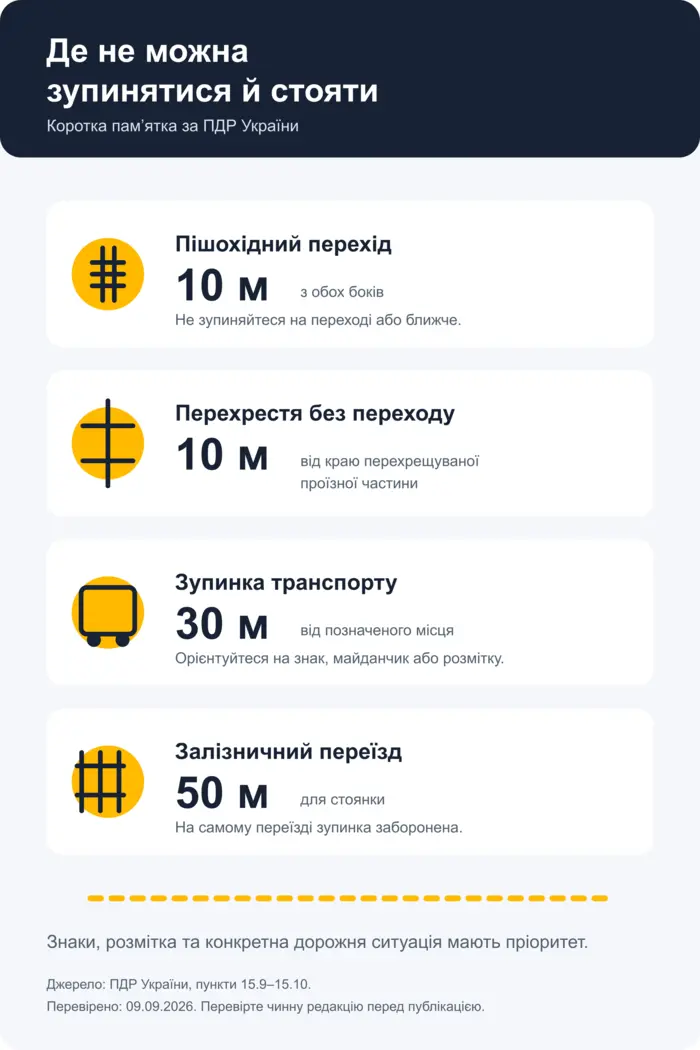
Measure from the relevant road feature or sign, not approximately from the bonnet of a nearby car. Road signs, markings and the actual traffic situation always take priority.
Stopping and parking are not the same thing
In everyday language, both actions are often called parking. Ukraine’s Traffic Rules distinguish between them. A stop is a halt of up to five minutes, or a longer halt needed for passengers to get in or out or for loading and unloading. Parking is a halt lasting more than five minutes for other reasons.
That distinction does not mean that a driver may stop “for just one minute” anywhere. If a location is prohibited for stopping, a brief unnecessary stop can still be a violation. Do not drop off a passenger on a crossing, at a public-transport stop, or where your car obstructs an exit from a residential area.
Where you cannot stop or leave a car
Section 15 of the Traffic Rules contains the complete list of restrictions. In practice, it is better to think about risk rather than memorising a list of fines: can pedestrians and other vehicles see clearly, is traffic blocked, and have you created an obstacle for people using prams, wheelchairs or emergency vehicles?
Do not leave a car on a pedestrian crossing, intersection, railway crossing, tram track, bridge, overpass or in a tunnel. Narrow sections where another vehicle cannot pass, areas with limited visibility, exits from adjacent properties and places marked with prohibitory signs are also unsuitable.
Check the full list and the special exceptions in clauses 15.9–15.10 of the Traffic Rules, rather than relying on social-media posts. Do not park in a second row or leave a car where it creates a traffic queue. If in doubt, drive on and choose a legal parking area.
Can you park on a sidewalk?
A sidewalk is primarily for pedestrians. The Traffic Rules allow passenger cars and motorcycles to park at the edge of a sidewalk only when at least 2 m remains clear for pedestrians. Road signs with supplementary plates may show the permitted way to position a vehicle.
Do not confuse the clear pedestrian width with a supposed universal distance from a residential building. The Traffic Rules do not set one general “10 metres from every apartment building” rule. Residential areas may also have signs, property-management rules, emergency-access requirements and local restrictions. Do not park on a lawn or block an entrance, waste-collection area, barrier gate or emergency route.
Parking near crossings, intersections and bus stops
If a crossing is marked with zebra stripes, do not leave a car on it or within the 10-metre zone. If there is no crossing but there is an intersection, measure 10 m from the edge of the intersecting carriageway, not from an imaginary centre point.
The 30-metre area near a bus, trolleybus or minibus stop allows public transport to enter safely and passengers to see the road. The restriction applies to the stop itself, even when no bus is currently there.
An exit from a yard, car park, petrol station or other adjacent property must remain visible and clear. Even without a painted line, do not leave a car where another driver would have to pull out blindly or into oncoming traffic.
Parking in residential courtyards
A residential courtyard is not automatically unrestricted parking. It may have homeowners’ association rules, signs, markings, barriers or separate conditions set by the landowner. A private sign alone, however, does not override the Traffic Rules or give anyone the right to block access.
Before leaving a car in a courtyard, check the following:
- Do not block access for a fire engine, ambulance or refuse truck.
- Leave a safe path for pedestrians, prams and wheelchairs.
- Do not block a sign, road marking, exit, gate or waste-collection area.
- Do not park on a lawn or landscaped area.
- Do not leave documents, devices or valuables visible in the car.
This checklist is also useful after collecting a rental vehicle. If you are planning your first self-drive trip in the country, read BLS guidance on driving a car in Ukraine.
What to do if your car has been towed
Do not interfere with an inspector or towing crew. Take photos of the location, signs and the car’s condition, then check the official city services or contact the authority that left the notice.
In Kyiv, the Kyiv Digital app includes parking services and tools for recovering a vehicle from an impound lot, according to the official Kyiv city portal. Penalties, towing and storage costs may vary by violation, city and current decisions, so do not rely on old fixed amounts found online.
If the situation involves a rental car, contact the rental company immediately using the contact details in your agreement. This helps everyone agree on the next steps quickly.
Parking in Kyiv
For municipal parking areas in Kyiv, do not rely on outdated advice about paper tickets or kiosks. Use the official Kyiv parking portal and the Kyiv Digital city app for current information.
Before paying, match the parking-area number on the physical sign with the number in the app. Payment rules, tariffs and special arrangements can change, so verify them before your trip. Additional official explanations are available from the Kyiv Department of Territorial Control.
Planning several meetings in different parts of the capital? Choose a car class that fits both your route and available parking space. You can view options on the BLS car rental in Kyiv page and review the BLS rental terms before booking.
Checklist before walking away from your car
- Check signs, road markings and your distance from a crossing, intersection or stop.
- Make sure the car does not block an exit, pedestrian route or emergency access.
- If parked at a sidewalk edge, leave at least 2 m for pedestrians.
- At paid parking, match the number on the sign with the number in the app.
- Do not leave documents, devices or valuables in the vehicle.
When parking after dark, avoid an unlit location where the vehicle may be difficult for other road users to notice. Choose a legal, well-lit parking area when possible, lock the vehicle, remove valuables from view and confirm that you have not left lights, windows or the boot open. These simple checks do not replace the Traffic Rules, but they reduce avoidable risks at the end of a journey.
If any answer is uncertain, move the car. A few extra minutes spent finding a legal space usually cost less than towing or creating a dangerous situation for other people.
Frequently asked questions
How far from a pedestrian crossing can I park?
Stopping is prohibited on a crossing and within 10 m of it on either side, except for cases expressly allowed by the Traffic Rules.
How far from an intersection can I leave my car?
Where there is no pedestrian crossing, stopping is prohibited at the intersection and within 10 m of the edge of the intersecting carriageway.
Can I park a car on a sidewalk?
A passenger car or motorcycle may stand at the edge of a sidewalk only if at least 2 m remains clear for pedestrians.
How far should I park from a public-transport stop?
The basic Traffic Rules requirement is 30 m from the marked stop.
Is there a general rule requiring 10 m from a residential building?
No. In a courtyard, check signs, emergency access, pedestrian routes, lawns and local rules for the property.