


Car sharing is short-term, self-service access to vehicles used by different members at different times. A customer typically finds and unlocks a nearby car through an app, drives it, and ends the session under the operator’s rules. Charges may be based on time, distance, a package, or a combination of these.
Traditional car rental is arranged for an agreed period, usually with a confirmed vehicle class and a defined collection and return process. Car sharing often suits a short one-way movement inside a service area. Rental is generally a better starting point for a full day, several days, an intercity itinerary, substantial luggage, or a trip that requires predictable access to the same vehicle.
Car sharing definition: what the term actually means
A practical car sharing definition is a membership-based system that gives customers self-service access to a shared vehicle fleet for relatively short periods. The user drives the car rather than being transported by a professional driver. The EU Urban Mobility Observatory defines car sharing as short-term vehicle access with self-service and payment based on time or distance.
The forms “car sharing,” “car-sharing,” and “carsharing” refer to the same broad category. Search results may also use “shared cars” or “car club,” although the precise commercial model can vary by market. The label alone does not tell you where a vehicle may be driven or returned, what the insurance excess is, or whether parking and fuel are included.
Car sharing is not ride sharing or a taxi
- Car sharing: the member temporarily takes control of a vehicle and drives it.
- Ride sharing or carpooling: people share a journey with a driver; passengers do not take possession of the car.
- Taxi or ride-hailing: the customer buys a transport service and remains a passenger.
- Conventional car rental: a customer books a car class for a stated rental period under a rental agreement.
This distinction matters when you compare prices. A taxi quote covers a completed passenger journey. A car-sharing rate covers vehicle access but leaves you responsible for driving, parking and following the operator’s rules. A rental quote covers a defined period and may list fuel, mileage and optional services separately.
Types of car-sharing services
The EU Expert Group on Urban Mobility’s recommendations distinguish station-based and free-floating car sharing. There is no single universal car-sharing setup. Before registering, identify which model a provider operates because it determines where you can find and leave the car.
Free-floating car sharing
Cars are distributed across an operating area rather than kept at one branch. A member can usually start a session at one permitted location and finish at another permitted location. “Free-floating” does not mean the vehicle may be left anywhere: traffic law, local parking restrictions and the app’s end-of-trip zone all still apply.
Station-based one-way
Vehicles are collected from designated stations and may be returned to a different approved station. This adds structure and can make availability easier to understand, but it provides less door-to-door flexibility than a free-floating area.
Round-trip car sharing
The member returns the vehicle to its original station or space. It can work well for a planned errand or appointment when the driver expects to come back to the starting point. The car normally remains allocated during stops, so waiting time or the booked duration needs to be included in the budget.
Peer-to-peer sharing
A platform connects drivers with privately owned cars. Availability can be broad, but identity checks, handover, insurance, vehicle standards and dispute procedures may differ from a centrally managed fleet. Read the platform agreement and the individual listing instead of assuming the same protection as a rental branch.
How does car sharing work?
The exact steps depend on the service. This sequence is a due-diligence guide, not a substitute for the operator’s instructions.
- Create an account. Provide the identity and driving documents requested by the service. Check minimum age, licence history and territory requirements.
- Accept the terms and payment method. Look for a deposit, pre-authorisation, membership fee, insurance excess and the time required to release blocked funds.
- Locate a vehicle. The app may show the car’s category, fuel or charge level, estimated walking distance and operating zone.
- Reserve it. A short reservation window may be free or chargeable. If you cannot reach the car in time, the booking can expire.
- Inspect before driving. Photograph the exterior, wheels, windows, interior and dashboard. Report any unrecorded damage using the designated channel.
- Drive within the rules. Follow traffic law and the service’s restrictions on territory, authorised drivers, refuelling, charging and vehicle use.
- End the session correctly. Park in an eligible place, remove belongings, close the windows, switch everything off, lock the car and wait for the app to confirm that billing has stopped.
Parking the car is not necessarily the same as ending the session. A weak data connection, an ineligible space or a missed checklist item may prevent closure. Keep the confirmation screen and receipt. If the app does not close the trip, contact support immediately and record the time.
Car sharing vs car rental: the essential differences
The two formats solve different planning problems. Car sharing prioritises quick access to whatever suitable car is available nearby. Rental prioritises confirmed access to a vehicle category for a stated period. Neither is automatically cheaper or more flexible until a route and its conditions are defined.
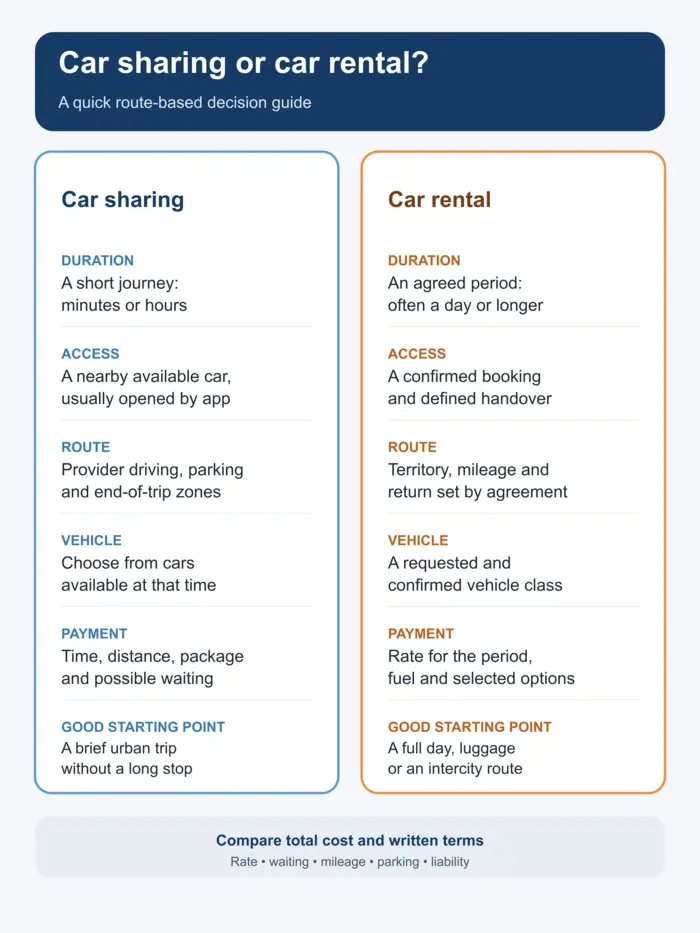
| Decision factor | Car sharing | Conventional rental |
|---|---|---|
| Usual purpose | Short access or a local urban journey | Planned use for a day or longer |
| Vehicle access | Self-service through an app or access card | Confirmed booking and a defined handover |
| Vehicle choice | Cars currently available in the area | A requested and confirmed vehicle class |
| Price structure | Time, distance, package or a combination | Rental period plus applicable options |
| Stops | Billing may continue while the car waits | The car remains available during the paid period |
| Geography | Operator-defined driving and end zones | Territory and mileage defined by the agreement |
| Return | Eligible zone, station or original space | Agreed place and time; one-way may be a separate service |
| Equipment | Whatever is present in the available car | Options can be requested in advance, subject to availability |
| Availability | Depends on real-time fleet distribution | Based on a confirmed reservation |
These are common patterns, not binding rules. A car-sharing operator may sell day packages; a rental company may offer delivery or contactless collection. Always compare two real offers for the same journey and date.
How to compare the total cost
A per-minute rate and a per-day rate are different units. Comparing the headline numbers without building the same journey for both options can point to the wrong answer. Write down the expected duration, distance, stops, parking locations, number of drivers and equipment before checking prices.
Car-sharing cost model
Total = driving and access time + distance or package + paid waiting + parking not covered by the service + applicable fees.
A short direct trip can be efficient. A meeting during which the car waits for three hours changes the equation. Ending the session may avoid waiting charges, but then the next car is not guaranteed. Congestion, a detour back into the end zone and the walk to an available vehicle are part of the practical cost even when they do not all appear on the receipt.
Rental cost model
Total = rate for the rental period + fuel or charging + parking and road charges + optional equipment and drivers + amounts arising under the selected protection and agreement.
Check the mileage policy for the selected rate, fuel policy, deposit, excess, additional driver, child seat, collection time and return location. BLS publishes general car rental terms, but the confirmation for the specific booking should be checked before payment because vehicle, route and service details may affect the offer.
Costs that are easy to overlook
- time spent in congestion or waiting with an active session;
- a detour needed to reach an eligible return area;
- parking that is not covered by the operator;
- airport, station, administration or relocation charges;
- adding a driver or requesting equipment;
- fuel, charging, road tolls and local access charges;
- the excess and exclusions if the car is damaged.
Terms to read before you book
A smooth app interface does not replace a contract. Open the complete rate sheet, insurance information and prohibited-use section. Save the version applicable to the booking if the service allows it.
- Driver eligibility: age, licence age, accepted documents and additional-driver procedure.
- Authorised territory: where the car may be driven, parked and finally returned. These areas may differ.
- What the rate includes: distance, fuel or charge, municipal parking, taxes, membership and service fees.
- Financial protection: excess, damage exclusions, security deposit and the effect of breaking a condition.
- Breakdown and collision procedure: who to call, what evidence to collect and whether moving the vehicle is permitted.
- Return standard: location, time, fuel or charge level, cleanliness, photographs, keys and electronic closure.
If a route is outside the normal city area, obtain a written answer before starting. A map that lets you view a destination is not evidence that driving or ending a trip there is allowed. For local preparation, see BLS’s guide to driving in Ukraine; current road signs and official restrictions remain decisive.
Vehicle inspection checklist
Inspecting the vehicle protects both safety and the record of responsibility. It is necessary whether the keys come from an employee, a lockbox or a mobile app.
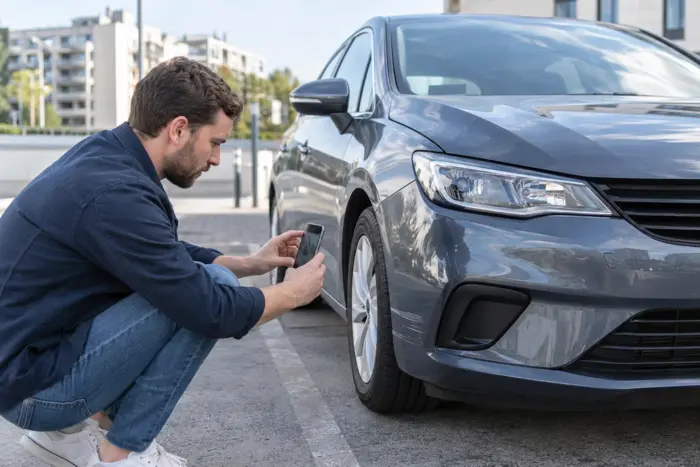
- Walk around the vehicle and photograph every side in adequate light.
- Record scratches, dents, glass chips, wheels and visible tyre condition.
- Photograph the cabin, luggage compartment and any agreed equipment.
- Capture the odometer, fuel or battery level and dashboard warnings.
- Test lights, mirrors, seat belts and wipers before joining traffic.
- Report any unlisted issue before moving and retain the response.
- Do not drive a car with a safety-critical fault; contact the service for instructions.
Repeat the record at return and keep the final receipt or closure screen. If a collision or breakdown occurs, follow traffic law and the operator’s reporting process. Do not improvise a private settlement or arrange repairs without authorisation.
Which option fits your journey?
A short urban trip
Car sharing can fit when a suitable vehicle is close, the drive is brief and the destination is inside the end zone. It is particularly relevant when you do not need the car after arrival. Check the parking layer in the app before departure, not after reaching the destination.
Several appointments in one day
Estimate how long the vehicle will sit between drives. Keeping a shared car preserves availability but may incur waiting charges. Ending each session may save that fee, but another car may not be available later. A day rental keeps one vehicle throughout the schedule, with fuel and parking calculated separately.
An airport or railway transfer
For car sharing, verify access to the exact terminal, eligible parking and any location fee. For rental, verify opening hours, meeting point, delivery and after-hours return. When a flight or train creates a hard deadline, a written confirmation of the collection procedure is more valuable than a general promise of availability.
A family journey or bulky luggage
Seat count alone does not show whether suitcases, a pushchair or sports equipment will fit. A child restraint must suit the child and be installed correctly. A shared car has only the equipment already present; a rental customer can request equipment and vehicle capacity in advance, subject to confirmation.
A day trip from Kyiv
Check the permitted territory, mileage, roadside support and return rules. If the vehicle needs to stay with you all day, a planned rental may be simpler to budget. The car rental in Kyiv page shows available categories; confirm the exact rate and route conditions for your dates.
An intercity journey
Do not assume that the ability to drive outside the operating zone also permits ending the booking elsewhere. Some shared-car services require the vehicle to return to its home area. Rental agreements may permit broader travel, but geography and mileage are still contractual terms rather than unlimited rights.
Cross-border travel or an international one-way return
Ordinary urban car sharing is rarely designed for this use. With a rental, border crossing and return in another country require the service to be available and approved in writing in advance. Confirm the permitted countries, vehicle category, documents, insurance, charges and exact receiving branch. A verbal assumption at collection is not sufficient.
A vehicle for several days
Compare any multi-day car-sharing package with a rental quote rather than multiplying a minute rate. The longer the trip, the more important mileage, support, replacement in case of a fault, luggage capacity and return flexibility become. A clear daily headline may still exclude a condition that changes the final result.
A one-minute decision guide
- Is the trip short and will you release the car at the destination?
- Is a suitable car reliably available nearby?
- Can the session be ended legally at the destination?
- Do you have no special requirement for class, luggage space or equipment?
- Is the complete price, including waiting and parking, competitive?
If every answer is yes, car sharing is a strong candidate. If two or more answers are no, calculate a conventional rental. For a multi-day, intercity, family or cross-border journey, start with the rental terms and compare alternatives from there.
When convenience matters more than the lowest theoretical price
A calculation based on perfect traffic and immediate vehicle availability may be fragile. Consider the consequence of a missing car, a meeting that runs late or an app that cannot close the booking. The best option is the one that remains workable under a realistic variation in the plan, not merely the one that wins by a small amount in an ideal scenario.
Common mistakes to avoid
- Comparing incompatible headline prices. Convert both offers into the total cost of the same journey.
- Confusing the driving area with the end zone. A car may be allowed on a road but not returnable at the destination.
- Skipping the pre-trip record. Photographs sent after a trip cannot establish the starting condition as clearly.
- Letting an unauthorised person drive. This may breach the agreement and change liability or insurance treatment.
- Assuming fuel or parking is always included. Inclusion can depend on the operator, city, station and payment method.
- Leaving without an end confirmation. Locked doors do not necessarily mean that billing has stopped.
- Relying on an old review. Zones, fees and fleet availability can change.
Is car sharing automatically the greener choice?
No transport label guarantees an environmental benefit. The outcome depends on what the journey replaces, vehicle occupancy, fleet technology, vehicle life, repositioning and whether the service reduces or encourages car travel. A shared car that replaces a private-car purchase may have a different effect from one that replaces walking, cycling or public transport.
For an individual trip, first ask whether a car is necessary. If it is, choose a vehicle class appropriate to passengers and luggage rather than an unnecessarily large model. Combine errands, avoid empty detours and follow efficient-driving principles. Environmental claims should be supported by service-specific evidence, not inferred from the word “shared.”
Bottom line
Car sharing means short-term self-service access to a shared fleet. It is often a good match for a brief local drive when a car is nearby and the trip can end in an eligible place. Conventional rental gives planned access to the same vehicle for an agreed period and is usually the more natural comparison for full-day, multi-day, intercity or equipment-dependent travel.
Define the route, calculate the complete cost, inspect the car and save the applicable terms. If you are considering BLS, review the current rental conditions and obtain written confirmation of any important route, driver or return requirement. The contract for the actual booking—not a generic comparison article—determines the final terms.
Frequently asked questions
What is the simplest car-sharing definition?
Car sharing is short-term, self-service access to vehicles that are used by different registered customers at different times. The customer drives and returns the vehicle according to the operator’s rules.
How does car sharing work?
A member normally verifies a driving licence and payment method, locates and reserves a car, records its condition, unlocks it, drives within the permitted area and ends the session at an eligible location.
Is car sharing the same as ride sharing?
No. In car sharing, the user takes temporary control of a vehicle. In ride sharing or carpooling, passengers join a journey with a driver and do not receive the vehicle for independent use.
Can a shared car be left anywhere?
No. The user must comply with traffic and parking law as well as the operator’s end-of-trip zone. The driving area and return area may be different.
Is fuel included in car sharing?
It depends on the service and rate. Even when fuel or charging is included, the operator may prescribe approved stations, payment cards and a minimum return level.
Is insurance included?
A vehicle may be insured while the driver still has an excess or liability under the agreement. Check exclusions and the required reporting process before driving.
Which is cheaper for one day?
Compare a car-sharing day package, if available, with a complete rental quote for the same route. Include mileage, fuel, waiting, parking, equipment, deposit and damage responsibility.
Can I take a car-sharing vehicle out of the city?
Only if the operator permits it. Confirm both the driving territory and where the session must end, plus mileage and roadside support.
Which option is better for a weekend trip?
Rental is usually the first option to examine when the car is needed continuously, the route leaves the city, or luggage and vehicle class matter. Car sharing may still work if a verified package and territory fit the complete plan