


Updated 13 November 2026.
Dashboard warning lights are grouped by colour. Red means danger: stop as soon as it is safe and switch off the engine. Yellow or amber means a fault that needs a garage soon. Green and blue only show that a feature is switched on. A flashing light is usually more serious than one that stays on.
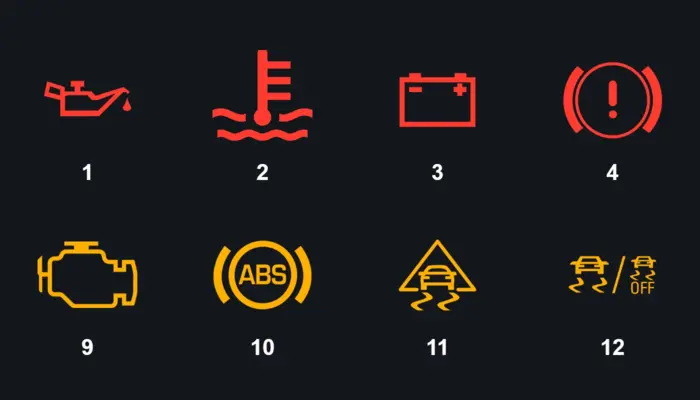
Below are the 27 most common dashboard symbols in three tables by colour; the number on each picture matches a row in the table. The exact set of lights depends on the make and model, so always check your owner's manual.
How to read dashboard lights: the colour rule
In most modern cars the colours follow the same logic as traffic lights:
- Red: a critical fault or a safety risk. Stop somewhere safe and switch off the engine.
- Yellow (amber): a fault or a warning. You can drive on carefully, but have the system checked soon.
- Green: a feature is on and working, such as dipped headlights or cruise control.
- Blue: main beam is on.
- White: information messages that vary by model.
The colours of the main warning lights are set by UN Regulation No. 121: oil pressure, coolant temperature and seat belt lights must be red, fuel level and rear fog lights yellow, indicators green and main beam blue. For other symbols, manufacturers follow the general colour scheme of ISO 2575.
Flashing has its own rule. A flashing Check Engine light means a severe misfire, while a flashing ESP light while driving just shows that the stability system is working.
Why all the lights come on when you start the car
When you switch on the ignition, most warning lights come on for a few seconds. This is a bulb check: the car shows that the lamps work. They should go out once the engine starts. Worry if a light stays on, or if the airbag or ABS light does not come on during the check, because a fault could then go unnoticed.
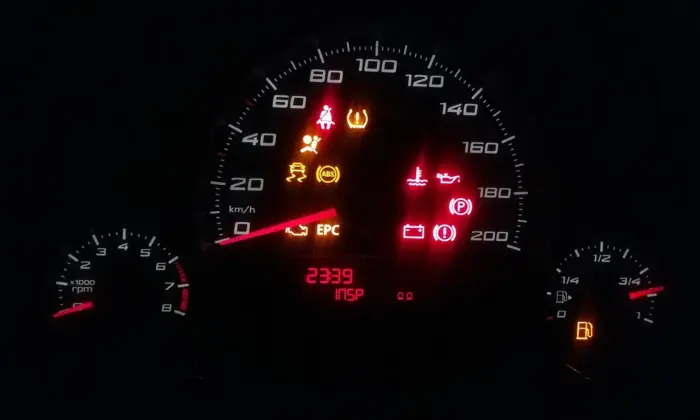
Photo: Wiki LIC / Wikimedia Commons, CC BY-SA 4.0
Red dashboard warning lights: stop
Do not ignore a red light, even for a few miles. Driving on can end with engine repairs or an accident.
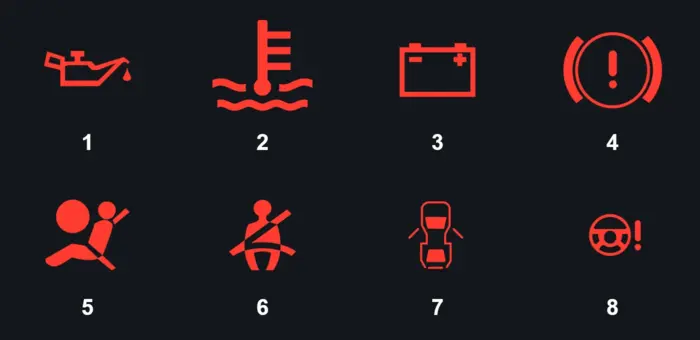
| # | Symbol | What to do |
|---|---|---|
| 1 | Oil pressure (oil can) | Stop and switch off the engine straight away, then check the oil level. Do not restart until the cause is found. |
| 2 | Coolant temperature (thermometer in waves) | Stop, switch off and let the engine cool. Never open a hot coolant tank. |
| 3 | Battery / charging (battery) | The alternator is not charging the battery. Switch off non-essential electrics and drive to a garage before the battery runs flat. |
| 4 | Brake system (exclamation mark in a circle) | Check that the parking brake is released. If it is and the light stays on, the brake fluid may be low: stop and call for help. |
| 5 | Airbag (person with airbag) | A fault in the airbags or seat belt tensioners. You can drive, but the airbags may not deploy in a crash, so have it checked as soon as possible. |
| 6 | Seat belt | Someone is not wearing a seat belt. Buckle up; a chime often sounds with the light. |
| 7 | Door open | Stop and close the door, boot or bonnet properly. |
| 8 | Power steering (steering wheel with exclamation mark) | The steering may become very heavy. Stop and restart the engine; if the light stays on, drive very carefully to a garage or call for help. |
Yellow warning lights: get it checked
Yellow gives you time to reach a garage, but it does not make the repair go away. The longer you drive with it, the bigger the bill can get.
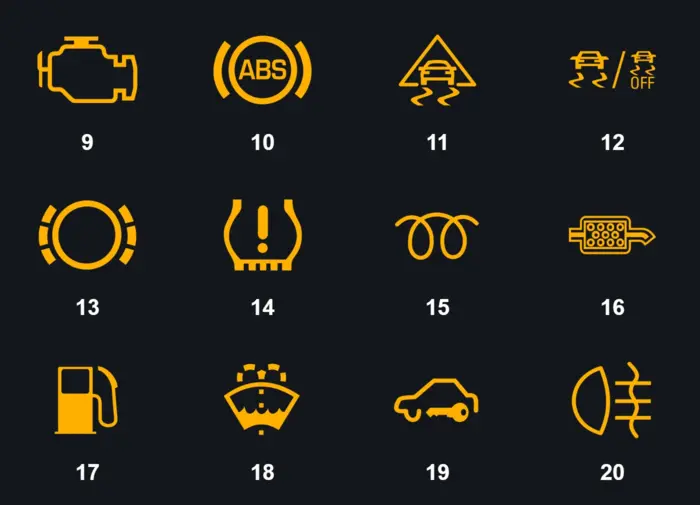
| # | Symbol | What to do |
|---|---|---|
| 9 | Check Engine (engine outline) | Steady: drive to a garage and have the codes read. Flashing: a severe misfire, so ease off and stop. Read more about what causes an engine misfire. |
| 10 | ABS | Normal braking still works, but the wheels can lock under hard braking. Leave more distance and have the system checked. |
| 11 | ESP/ESC (car with skid marks) | Flashing while driving: the system is intervening, so slow down. Steady: a stability control fault. |
| 12 | Traction control off (TC/ESP OFF) | The system has been switched off with the button. Switch it back on, especially on slippery roads. |
| 13 | Brake pad wear | The pads are nearly worn out. Book a replacement soon. |
| 14 | Tyre pressure (TPMS) | Check the pressure in all tyres, inflate to the correct value and store the new pressures in the menu. See also our guide to the signs of dangerous tyre wear. |
| 15 | Glow plugs (coil, diesel) | On for a few seconds after switching on the ignition: wait until it goes out, then start. On or flashing while driving: an engine management fault. |
| 16 | Diesel particulate filter (DPF) | The filter is clogged with soot. A motorway run usually helps: Volkswagen, for example, advises at least 15 minutes of steady driving at 60 km/h (about 40 mph) or more. |
| 17 | Low fuel | You are on the reserve; fill up soon. |
| 18 | Low washer fluid | Top up the screenwash. In winter use an antifreeze washer fluid. |
| 19 | Immobiliser (car with key) | The car does not recognise the key. Try the spare key or replace the key fob battery. |
| 20 | Rear fog light | The rear fog light is on. Switch it off when visibility is good, as it dazzles drivers behind. |
Green and blue lights: a feature is on
These lights do not mean anything is wrong; they confirm that a feature is working.
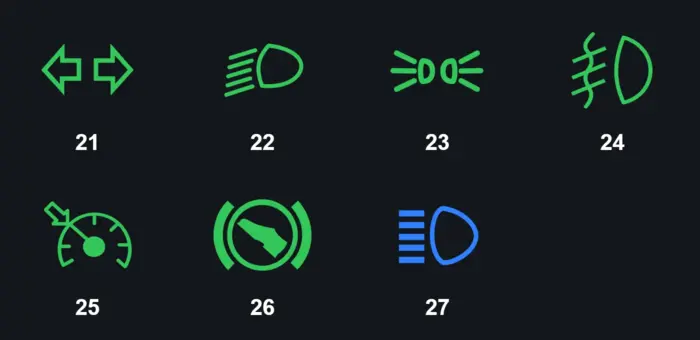
| # | Symbol | What it means |
|---|---|---|
| 21 | Indicators | A turn signal or the hazard lights are on. If the arrow flashes twice as fast, an indicator bulb has failed. |
| 22 | Dipped headlights | The headlights are on. |
| 23 | Side lights | The side (position) lights are on. |
| 24 | Front fog lights | The front fog lights are on. |
| 25 | Cruise control | The system is holding the set speed. |
| 26 | Press the brake pedal | Press the brake to start the engine or move an automatic gearbox out of P. |
| 27 | Main beam (blue) | Main beam is on. Dip the lights when another car approaches. |
Lights that are easy to confuse
- Yellow and red oil can. Yellow usually means a low oil level that needs topping up. Red means low oil pressure: switch the engine off immediately.
- Exclamation mark in a circle and exclamation mark in a tyre shape. The first is the brake system or parking brake, the second is tyre pressure.
- Flashing and steady ESP. Flashing while driving shows the stability system working; a steady light means a fault or that the system is switched off.
- The coil on a diesel. For a few seconds after switching on the ignition it is normal glow plug preheating; while driving it signals an engine fault.
Electric and hybrid car warning lights
Electric and hybrid cars add lights you will not find in a petrol car:
- READY (or a green car with arrows): the car is ready to drive. You will not hear an engine, but it moves as soon as you press the pedal.
- Turtle: power is limited, usually because the traction battery is low or too hot. Charge the car or let the battery cool down.
- Battery with a lightning bolt, or an exclamation mark with a high-voltage message: a fault in the high-voltage system. Stop, call for help and do not inspect anything yourself.
- Charging plug: the car is plugged in, or charging has been interrupted.
These symbols vary between brands much more than conventional ones, so check the manual for your model.
How warning lights differ between brands
The basic symbols (oil, temperature, brakes, Check Engine) are standardised and look almost the same in every car. The differences are in brand-specific systems: driver assistance, hybrid and electric drive, diesel exhaust treatment. Volkswagen, for example, has a separate EPC light and AdBlue range warnings; we cover them in our guide to Volkswagen dashboard warning lights.
The layout differs too: in cars with a digital instrument cluster, some warnings appear as text on the central display rather than as a separate lamp.
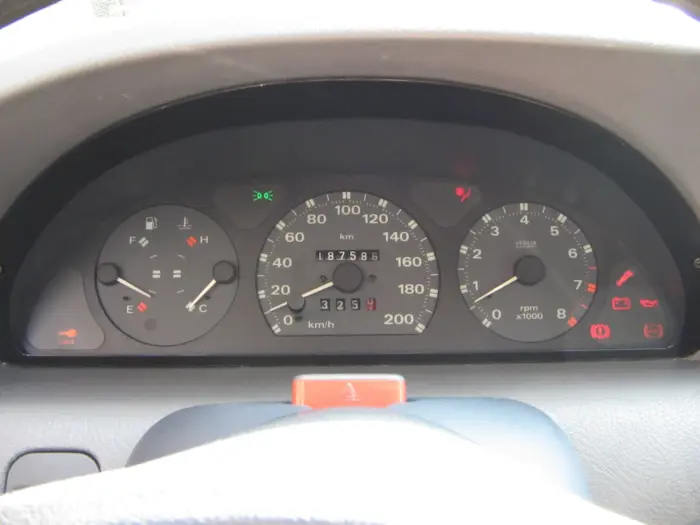
Photo: Zoidy / Wikimedia Commons, public domain
What to do when a warning light comes on
- Look at the colour. Red: stop as soon as it is safe and switch off the engine. Yellow: drive on carefully to a garage.
- Check what you can yourself: the parking brake, the fuel cap, the oil and coolant levels with the engine cold, and the tyre pressures.
- Look the symbol up in the owner's manual; most manufacturers publish a digital version online.
- If the light stays on, read the codes with an OBD-II scanner or book a diagnostic check.
Before a long journey, glance at the dashboard during the bulb check; the rest is in our checklist on how to prepare a car for a long trip.
A warning light comes on in a rental car
The colour rules are the same in a rental car, but you sort out the fault together with the rental company rather than on your own. If a red light comes on, stop somewhere safe, switch off the engine and call the rental company. Report a yellow light too, so the staff can tell you whether it is safe to carry on. Take a photo of the dashboard: it helps identify the problem faster. Do not clear fault codes or top up fluids without agreement.
If your own car is stuck in the garage, consider a car during repairs, or for a short trip try one-day car rental.
Volkswagen Golf 8 from the BLS fleet
FAQ
What is the most serious dashboard warning light?
The red oil pressure, coolant temperature and brake system lights. Stop as soon as it is safe when you see them, because driving on can damage the engine or the brakes.
What does a red exclamation mark in a circle mean?
It is the brake system warning light. Most often it means the parking brake is still on. If the brake is released and the light stays on, check the brake fluid level and do not drive on until it is checked.
The Check Engine light is on but the car drives normally. Can I keep driving?
If the light is steady and the engine runs smoothly, you can drive carefully to a garage. If it flashes or the engine shakes, ease off and stop: unburned fuel can damage the catalytic converter.
Why do all the dashboard lights come on at start-up?
It is a bulb and system check. The lights should go out within a few seconds of starting the engine. A light that stays on points to a fault.
What does a yellow dashboard light mean?
Yellow means a fault or a warning: have the system checked soon. The exact meaning depends on the symbol; look it up in the tables above or in your owner's manual.