


Updated 15 October 2026.
Before a long road trip, check the tyres, brakes, fluid levels, lights and wipers; prepare your documents, emergency equipment and a route with rest stops. Resolve faults before setting off and follow the servicing instructions for your particular vehicle. If you are renting, add a handover inspection and a check of the rental agreement.
This checklist separates straightforward driver checks from work that belongs with a qualified technician. It covers preparing for travel in Ukraine. Check documents and requirements for an international route separately.
A quick checklist before you leave
| What to check | What the driver can do | When to seek professional help |
|---|---|---|
| Tyres | Inspect tread and sidewalls; measure pressure when cold | Cuts, bulges, pressure loss or uneven wear |
| Brakes and steering | Notice unusual sounds, vibrations or changes in handling | A change in pedal operation, pulling to one side or a suspected fault |
| Fluids | Check accessible levels using the procedure in the handbook | A leak, a low level or a dashboard warning |
| Lights and visibility | Check headlights, brake lights, indicators, wipers and washers | Failed lights, damaged glass or poor demisting |
| Battery | Notice difficulty starting | Slow starting, repeated discharge or a system warning |
| Cabin and luggage | Buckle up, secure luggage and keep the pedal area clear | A faulty belt or seat mounting |
| Documents and equipment | Check the kit, access to it and document validity | Missing documents or required equipment |
| Route and driver | Plan rest, fuel or charging stops; check the weather | Driver fatigue or conditions that justify postponing the journey |
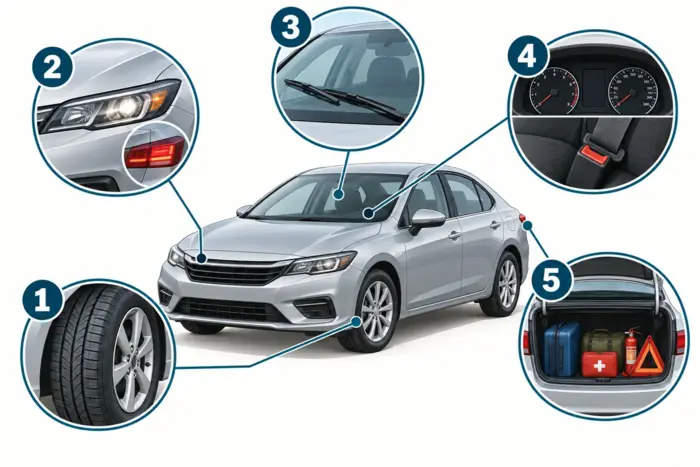
Arrange servicing and check fluids in advance
If a scheduled service is due soon, the maintenance history is unknown or a new symptom has appeared, arrange a workshop visit in advance. Allow time for diagnosis, repairs and checking the result. A technician should assess brakes, suspension, steering and drive components according to the manufacturer's schedule and their actual condition.
Check and replace engine oil, coolant and brake fluid according to the instructions for the particular model. There is no universal requirement to replace brake fluid twice a year. A low level or a leak is a reason to investigate the cause, rather than simply topping up and setting off. Do not mix fluids at random.
Carry out only accessible checks described in the handbook. Do not open the coolant reservoir cap while the cooling system is hot. If you do not know the required specification or procedure, contact a workshop, or BLS if the vehicle is rented.
Tyres: pressure, damage and puncture equipment
Measure pressure before driving, when the tyres are cold. NHTSA describes cold tyres as those on a vehicle that has not been driven for at least three hours. Use the vehicle's pressure label or handbook, allowing for the load. The maximum pressure on a tyre sidewall is not the recommended pressure for your car.
Inspect the sidewalls and tread for cuts, bulges and uneven wear. Adequate tread depth alone does not make a damaged tyre safe. Check the spare wheel or factory puncture kit if supplied with the vehicle. Know how to request assistance after a puncture. Tyre, fluid and lighting checks are also covered by NHTSA's road trip preparation guidance.
Documents and equipment for driving in Ukraine
Check your driving licence for the appropriate vehicle category, the vehicle registration document and valid Ukrainian third-party liability cover, known as ОСЦПВ. Have the documents available in a format permitted by the applicable rules. For a rental car, check the documents BLS hands over and keep the agreement and support contacts accessible. This list does not replace the documents required for crossing a border.
The car should have an appropriate first-aid kit, a working fire extinguisher and a warning triangle or the flashing red warning lamp allowed by the rules. Ukraine's Ministry of Internal Affairs explains this equipment requirement. Check condition, expiry dates and accessibility, rather than simply whether the items are present.
Also prepare:
- a phone, charger, power bank and offline maps;
- drinking water, personal medication and clothing for the weather;
- a torch, reflective vest and gloves;
- wheel equipment appropriate to the car's specification and handbook.
Secure heavy items in the luggage compartment, keep your view clear and stay within the vehicle's load limit. Choose and fit a suitable child restraint before departure; see the guide to transporting children in Ukraine for details.
Summer, winter and changing weather
Preparing your car for a summer trip
Check the air conditioning, cooling system and drinking water supply. Never leave children in a parked car.
Preparing a car for a winter trip
Check that the tyres suit the route conditions, test heating and demisting, and check the battery and washer fluid's frost protection. Carry warm clothing; do not rely solely on engine heating.
Preparing the vehicle in the off-season
In wet weather, pay particular attention to wipers, clean glass, lighting and tyre condition. Poor visibility can be a reason to change your departure time or travel plans.
For an electric vehicle, plan compatible charging stations, a backup charging location and a sufficient charge reserve. Use realistic route conditions rather than relying only on the advertised range.
Plan the route and the driver's rest
Check the forecast, road conditions and current local restrictions. Download a map and identify rest areas, fuel or charging stops and an alternative route. Do not plan each day around a universal kilometre target: the same distance can require very different amounts of time and effort.
As a practical safety guideline, Rule 91 of the British Highway Code recommends a break of at least 15 minutes after every two hours of driving. This is cited as safety advice, not as a statement of Ukrainian law. If you become sleepy, stop earlier in a safe place. Do not sacrifice rest to keep to a schedule.
Preparing a BLS rental car for your trip
At collection, inspect the body, glass, wheels and interior with the BLS representative. Record existing damage in the handover report and take photographs. Check fuel or charge, mileage, documents and any equipment you ordered. Adjust the seat and mirrors and locate the controls before moving off.
Estimate your route before choosing a rate: Base has a 250 km daily allowance, while Prime provides unlimited mileage regardless of rental duration for eligible vehicles. See the BLS FAQ for the rate conditions. If another person will drive, arrange their approval and inclusion in the agreement in advance.
Taking a rental vehicle outside the country of rental requires BLS's prior written permission under the rental terms. Agree on the route, documents, insurance and territorial restrictions separately. A booking confirmation alone does not authorise international travel.
When to postpone the journey
Do not set off with a suspected fuel leak, faulty brakes or steering, dangerous tyre damage or an unexplained safety system warning. A strong fuel smell or visible leak needs professional attention. Do not patch fuel lines with tape or a fuel tank with repair putty to continue your journey.
If you break down, stop in a safe place, mark the stopped vehicle as required and look after your passengers. If you suspect a fuel leak, switch off the engine and do not restart it; avoid flames and smoking. Contact emergency services if there is a fire, an injury or an immediate danger. In a fire, leave the vehicle and move away from it and traffic. Do not return for belongings or open the bonnet if you suspect a fire underneath it. These actions are described by the US Fire Administration, USFA.
For a rental vehicle, contact BLS on +38 067 329 26 26 and agree on the next steps with BLS Assistance 24/7. Do not arrange repairs or recovery independently without contacting the company, unless immediate action is necessary for safety. The assistance available and any costs depend on the situation and the agreement.
Frequently asked questions
Should I replace every fluid before a long trip?
No. Check levels, condition and when maintenance is due under the particular model's service schedule. Topping up does not fix the cause of a leak.
Is a quick check before departure enough?
It can reveal obvious problems but does not replace diagnosis when there are symptoms, an unknown maintenance history or an overdue service.
Can I skip the inspection when renting a car?
You should still inspect it together, complete the handover report, take photographs, check the equipment and familiarise yourself with the controls.
Author: Stefen Blagovisniy, co-founder and director of BLS Car Rental.