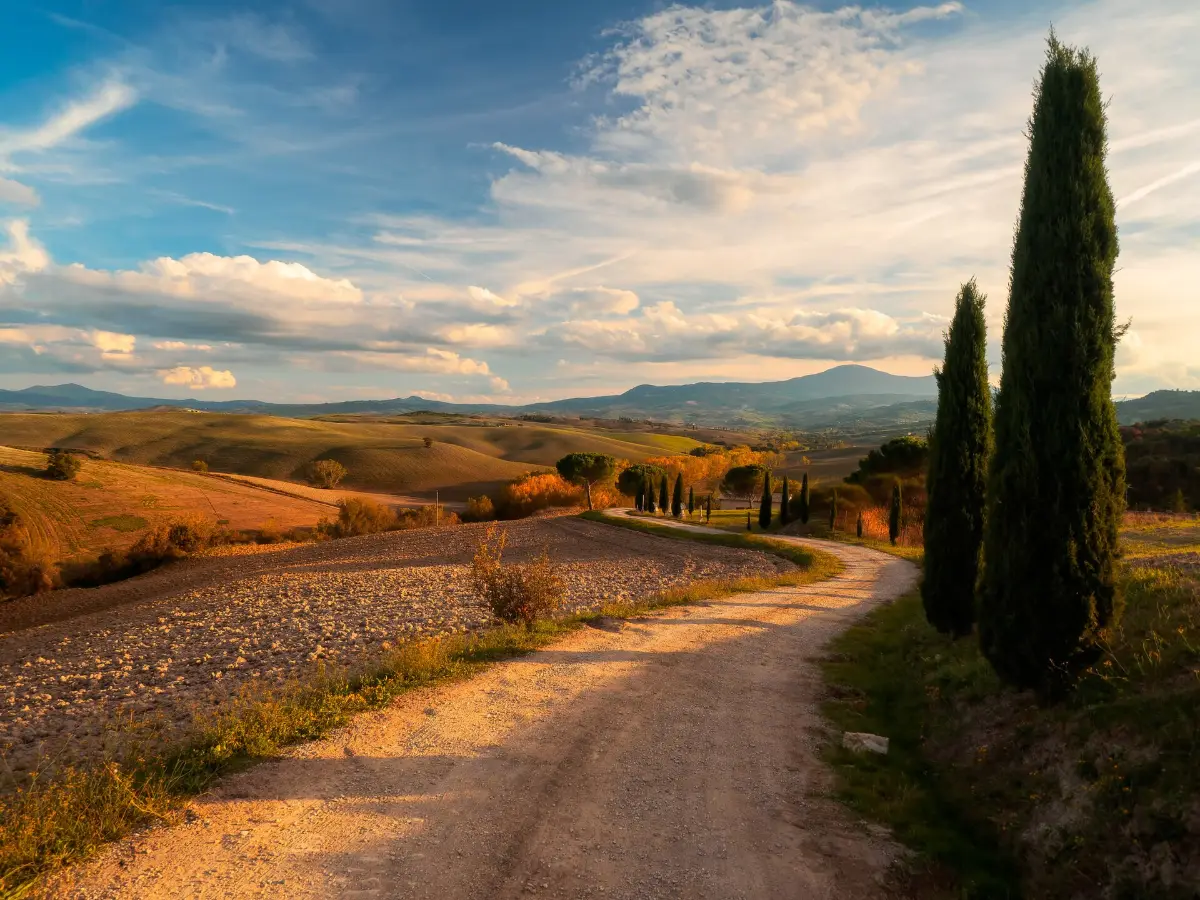
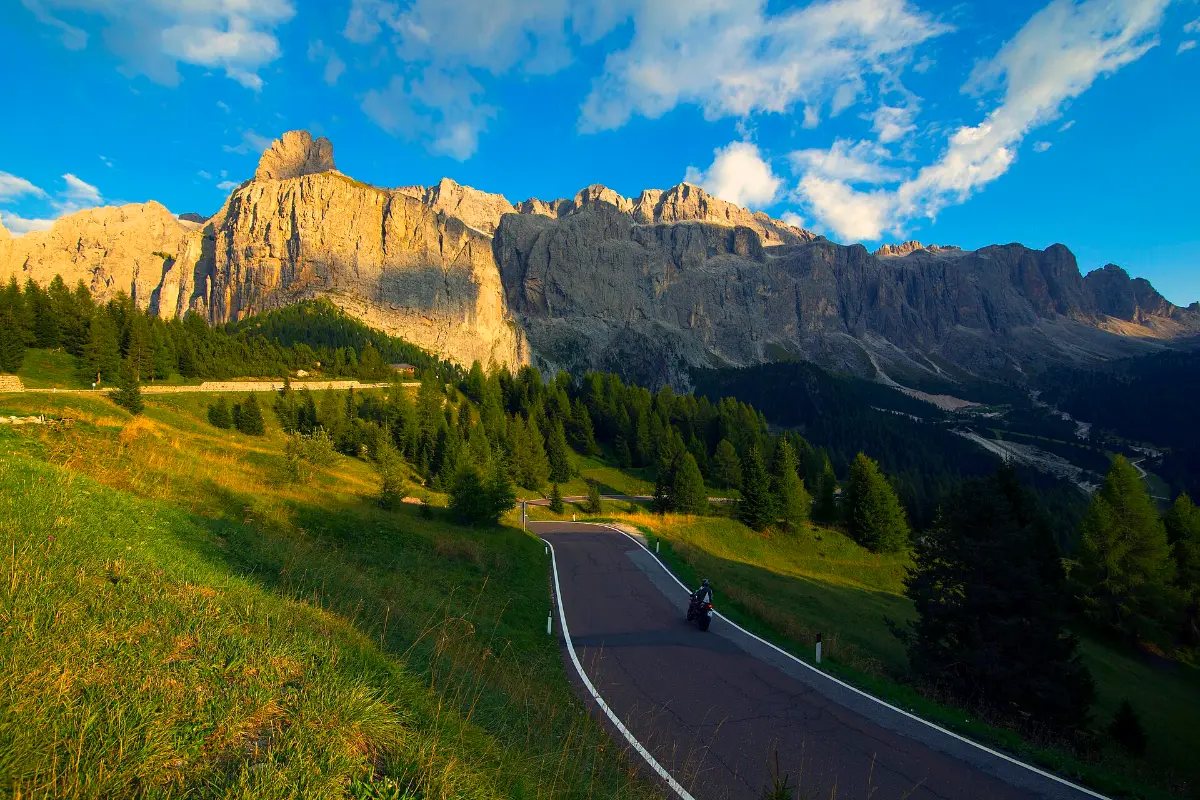
Trains work well between Italy's big cities, but they won't take you into the Tuscan hills, over the Dolomite passes or to small towns around the lakes. That is where car rental in Italy pays off: you can turn down a gravel lane to a winery or stop at a viewpoint without planning your day around a bus.
The form below compares local and international companies at airports and in cities across mainland Italy. You book on the site of our partner Discover Cars, where the full price, insurance terms, deposit amount and fuel policy are visible before you pay.
The form opens with Rome Fiumicino Airport selected. To search elsewhere, start typing a city or airport name, such as Milan Malpensa. Prices in the form are in US dollars.
Rome has two airports. Fiumicino, the main international one, is about 37 km from the centre. Ciampino is about 15 km out and mostly handles low-cost flights, currently Ryanair and Wizz Air above all. Milan has three options: Malpensa about 51 km from the centre, Linate about 8 km and Bergamo about 57 km.
For a whole trip, collect the car at your arrival airport and you never have to enter a historic centre. A city office suits a short trip, but check the route out first: ZTL zones close parts of many centres.
Sicily and Sardinia are reached by ferry or flight, and the form lists them as separate locations. Flying and collecting a car on the island is simplest. For a ferry, ask the supplier first whether it is allowed.
The table covers the two biggest airports, Rome Fiumicino and Milan Malpensa. Figures are average daily prices in euros from the Discover Cars page updated on 3 November 2026.
| Months | Rome Fiumicino, per day | Milan Malpensa, per day |
|---|---|---|
| January, February | about €13–14 | about €25–31 |
| March, October | about €18 | about €24–27 |
| April, May | about €25 | about €30 |
| June | about €27 | about €36 |
| July | about €32 | about €43 |
| August | about €25 | about €35 |
| September | about €24 | about €41 |
| November | about €13 | about €19 |
| December | about €26 | about €31 |
Malpensa costs more than Fiumicino every month, and in February and September the gap reaches €17–18. July is the most expensive month at both airports, November the cheapest. These are averages, not a price for your dates.
To rent a car in Italy you will need a passport, your driving licence and a bank card in the driver's name. Minimum age and experience vary by company and are listed in each offer.
Article 135 of Italy's Highway Code asks drivers with non-EU licences for an International Driving Permit (IDP) or an official Italian translation, with a fine of €408–1,634 for driving without one. The article has a clause about international conventions, but we found no official explanation for Ukrainian tourists. So carry an IDP with your national licence and confirm the requirements with the supplier before booking.
If you hold temporary protection in the EU, Regulation 2022/1280 applies and you need neither an IDP nor a certified translation. It does not cover tourists without that status.
The deposit is often blocked on a credit card in the driver's name, and a debit card may be refused. The amount depends on the car and the insurance. European Consumer Centres explain it this way: with insurance from a platform, the deposit equals the excess. With the rental company's own insurance it may be reduced or dropped, though a small sum can still be held for fines. So check any "no deposit" wording against the offer's terms.
Limits are 130 km/h on motorways, 110 on main rural roads, 90 on other rural roads and 50 in towns, or up to 70 where signed. In rain or snow they drop to 110 on motorways and 90 on main rural roads. In your first three years of driving, the maximums are 100 and 90 on those roads.
Dipped headlights are required outside built-up areas, day and night. The alcohol limit is 0.5 g/l.
From 15 November to 15 April, signed roads require winter tyres or chains on board, and the auto club ACI gives a fine of €87–344. Dates can differ between provinces. For winter mountain trips, ask the supplier which tyres the car has.
Tolls are a rate multiplied by kilometres, plus 22% VAT, so use the Autostrade calculator for your route. Major cards carry no surcharge.
Yellow, marked Telepass, is only for cars with that device. Blue takes cards only. White is for cash, and the machine gives change. Rental companies often offer Telepass for a daily fee.
If you can't pay at the exit, you get a receipt and 15 days to settle it at no extra cost. After that, administrative costs go to the car's owner, the rental company.
A ZTL (zona a traffico limitato) is a restricted traffic zone set by the municipality. Many cities enforce them by camera: in Milan, for example, electronic gates read your plate. Fines run from roughly €80 to roughly €330 in 2026, as amounts are indexed. On a rental the company may add an administrative fee, and the letter can arrive months later.
Rome's ZTL Centro Storico is closed on weekdays from 6:30 to 18:00, while Milan's Area C runs on weekdays from 7:30 to 19:30 and costs €7.50 a day in 2026. If your hotel is inside a zone, ask whether it can pass your plate to the authorities. The procedure differs by city and often only covers checking in with luggage.
The safest plan is to park outside the centre. In Rome, blue-line parking costs €1 an hour outside the ZTL and €1.20 inside it in 2026, with hours shown on the meter.
Starting in the capital? Our guide to car hire in Rome has the ZTL timetables and explains the Fascia Verde zone. For Malpensa, Linate and the lakes, read how to rent a car in Milan. More countries are in our car rental abroad section.


