


Ukrainian license plates in the familiar passenger-car format have two regional letters, four digits and a final two-letter series. AA at the beginning identifies Kyiv city; AI identifies Kyiv Oblast, a separate region. A territorial prefix usually relates to the place where the registration service was provided, rather than the owner's home address. Online registration uses separate prefixes, including DI, PD, ED and DC, without a regional meaning.
Checked on 16 October 2026. Use the table for a quick lookup, then see how to distinguish a regional prefix from a series, read different colours and check the plates when collecting a rental car.
Regional Codes and Series of License Plates
Ukrainian license plate codes in the table follow Annexes 4 and 6 of the current Ministry of Internal Affairs requirements, Order No. 166. It includes all four listed territorial letter combinations for each region. A code being legally listed does not establish that a particular service centre is already issuing it or has your preferred combination available.
Read Ukrainian license plates according to the plate type and the position of each character. To decode a car registration number, separate the regional prefix from the series after the digits. The map locates each region; the text table below lists every permitted regional combination.
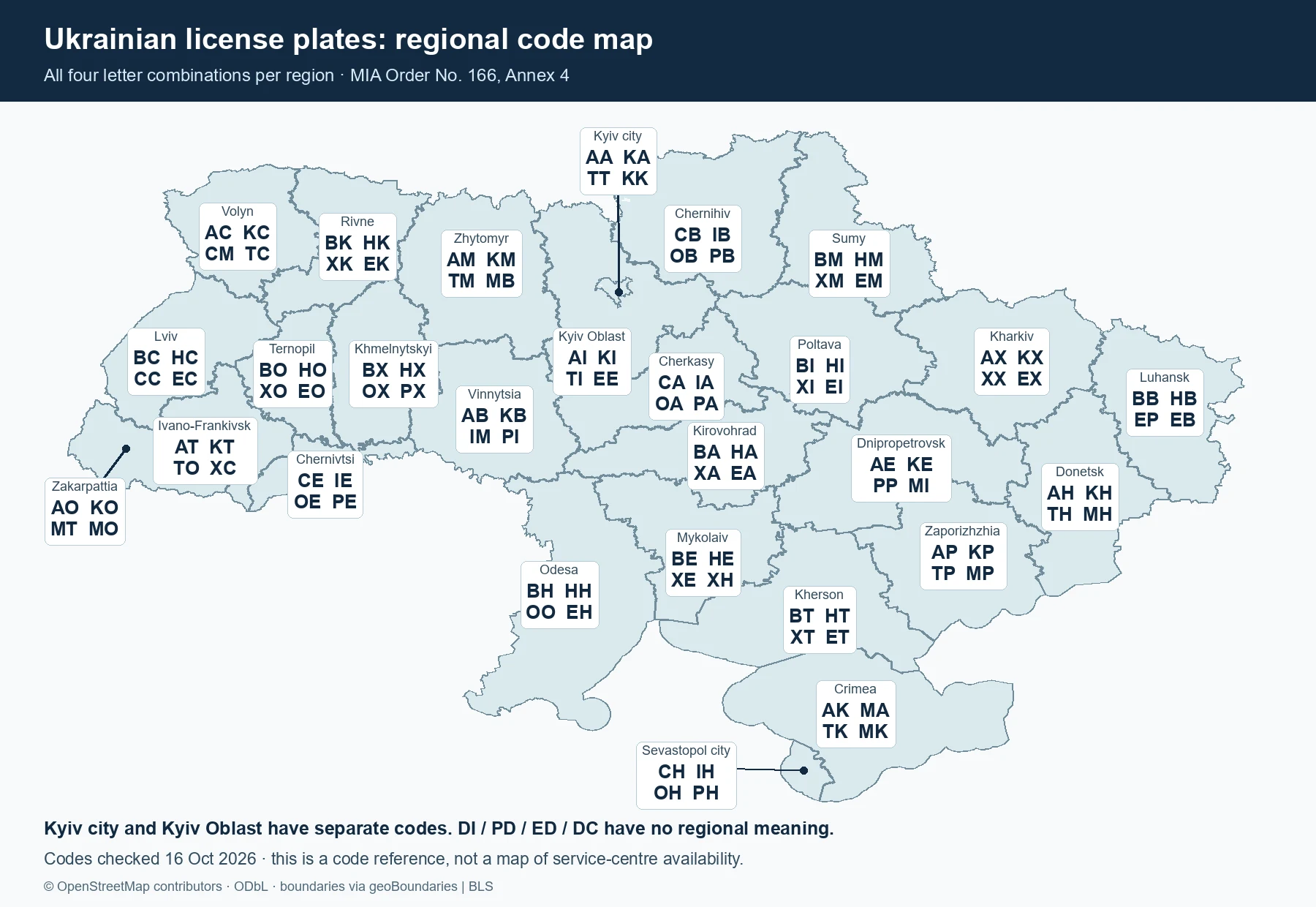
All license plate codes of Ukraine
| Region | Letter codes | Numeric code |
|---|---|---|
| Autonomous Republic of Crimea | AK, MA, TK, MK | 01 |
| Vinnytsia Oblast | AB, KB, IM, PI | 02 |
| Volyn Oblast | AC, KC, CM, TC | 03 |
| Dnipropetrovsk Oblast | AE, KE, PP, MI | 04 |
| Donetsk Oblast | AH, KH, TH, MH | 05 |
| Zhytomyr Oblast | AM, KM, TM, MB | 06 |
| Zakarpattia Oblast | AO, KO, MT, MO | 07 |
| Zaporizhzhia Oblast | AP, KP, TP, MP | 08 |
| Ivano-Frankivsk Oblast | AT, KT, TO, XC | 09 |
| Kyiv Oblast | AI, KI, TI, EE | 10 |
| Kyiv city | AA, KA, TT, KK | 11, 31 |
| Kirovohrad Oblast | BA, HA, XA, EA | 12 |
| Luhansk Oblast | BB, HB, EP, EB | 13 |
| Lviv Oblast | BC, HC, CC, EC | 14 |
| Mykolaiv Oblast | BE, HE, XE, XH | 15 |
| Odesa Oblast | BH, HH, OO, EH | 16 |
| Poltava Oblast | BI, HI, XI, EI | 17 |
| Rivne Oblast | BK, HK, XK, EK | 18 |
| Sumy Oblast | BM, HM, XM, EM | 19 |
| Ternopil Oblast | BO, HO, XO, EO | 20 |
| Kharkiv Oblast | AX, KX, XX, EX | 21 |
| Kherson Oblast | BT, HT, XT, ET | 22 |
| Khmelnytskyi Oblast | BX, HX, OX, PX | 23 |
| Cherkasy Oblast | CA, IA, OA, PA | 24 |
| Chernihiv Oblast | CB, IB, OB, PB | 25 |
| Chernivtsi Oblast | CE, IE, OE, PE | 26 |
| Sevastopol city | CH, IH, OH, PH | 27 |
The numeric regional codes in the last column belong to specific plate types, including personalised plates. They are not the four central digits on a normal passenger-car plate. For example, 14 identifies Lviv Oblast, while 11 and 31 identify Kyiv city. Crimea and Sevastopol are included as listed in Ukrainian legislation; this is not a directory of currently available service locations.
Kyiv city, Kyiv Oblast and Vinnytsia
- Kyiv city: AA, KA, TT, KK. Kyiv Oblast: AI, KI, TI, EE. Do not combine these separate entries.
- Vinnytsia Oblast: AB, KB, IM, PI. OK and MM are not its territorial codes in the current Annex 4.
- Lviv Oblast: BC, HC, CC, EC; Odesa Oblast: BH, HH, OO, EH; Kharkiv Oblast: AX, KX, XX, EX.
Letter codes here use Latin characters matching the visible shapes of the Ukrainian letters in the official table. This is a visual rendering, not a pronunciation guide: a Ukrainian В looks like B and Н looks like H. Do not transliterate a plate as if it were a Ukrainian place name.
Structure of Modern License Plates
The diagram below explains a standard single-line passenger-car plate. It is a schematic example, with no connection to a particular vehicle or person.
| AA | 1234 | BC |
|---|---|---|
| Regional prefix | Numeric part | Series |
The flag and UA at the left identify Ukraine. In this example, 1234 is the sequential numeric part; it does not independently tell you the model year, city or owner's status. The final BC is the series. BC indicates Lviv Oblast only when it appears in the regional position at the beginning of a territorial plate.
The regional table concerns territorial letter combinations. Motorcycles, trailers, temporary plates, personalised plates and service vehicles can have different layouts and character counts. The two-letter, four-digit, two-letter pattern should not be applied to every vehicle category.
Regional prefixes and plate series are different
People sometimes use “series” when they mean the first two letters. On a standard territorial plate, the regional prefix identifies the territorial association of the registration service; the series is the pair after the digits. Permitted series are listed separately in Annex 5 and depend on the plate type.
New series enter use as available combinations are issued. Two service centres in the same region can issue different series at the same time. The final pair should not be used to infer a region, an owner's profession or whether a vehicle is rented. Ukrainian number plates need to be read according to the position of each part.
Familiar territorial codes use letters with matching Cyrillic and Latin shapes. However, the claim that all Ukrainian plates use only those 12 letters is too broad. Electric vehicles and other subtypes have separate series lists that include additional Latin letters. A regional code and an electric-vehicle series are not interchangeable.
DI, PD, ED and DC: online registration prefixes
These combinations replace the territorial designation but do not identify an oblast. The requirements provide DI and PD for contracts made through the Diia portal, and ED and DC for contracts through the electronic Driver's Cabinet. Do not look for DI under Dnipropetrovsk or any other region.
Types of License Plates by Color and Purpose
A standard passenger-car plate normally has a white field with black characters. Other categories require attention to colour, layout, emblems and vehicle type together. Colour alone is not a complete decoder.
Blue plates
A blue field with white characters is specified for particular National Police plates. It is not a general label for every government vehicle. The relevant type has its own layout, including a numeric regional code and an emblem.
Black plates
A black field with white characters is specified, among other cases, for military plate types 9 and 10. Do not group every emergency-service, border-guard or National Guard vehicle under “black plates”: separate types with their own emblems and designations are specified for these services.
Yellow plates
Yellow fields are specified for certain bus and taxi subtypes used in passenger-transport business activity. Characters may be black or green, depending on subtype. Yellow is not the universal plate colour for all passenger vehicles or rental cars.
Green plates
This usually means green characters, not a green field. The special electric-car subtype is for vehicles powered by an electric motor without an internal combustion engine. A hybrid does not automatically belong to this category.
The current Annex 5 lists electric-vehicle series starting with letters including Y, Z, Q and U. The statement that only Y remains and Z has been completely removed does not match the current list. These are series, not additional regional codes, and actual availability must be checked separately.
Red plates
Red fields are used for specified single-trip plate types. Their layouts and rules differ from permanent registration. A red plate should not be read simply as an ordinary territorial plate with a different background.
Diplomatic plates
The current requirements specify an olive field with white characters and CD, CC or S designations for diplomatic subtypes 4-1 to 4-6. The three digits following the letters and the final three digits have separate meanings. An older description limited to white plates with D does not cover all current subtypes.
Special and Personalized Plates
A personalised plate bearing a chosen inscription differs from a normal registration plate with preferred digits. The former has requirements for its inscription and approval; the latter involves choosing an available letter-and-number combination within an established format.
Personalised plates are additional plates valid only within Ukraine. The vehicle keeps its standard registration plates. Before driving abroad, fit those standard plates: a personalised inscription does not replace them for international travel.
A personalised plate may include a permitted graphic element, such as a logo, subject to design requirements and the right to use the image. Using another owner’s trademark requires their permission. The MIA service centre’s explanation of inscription and symbol restrictions also covers Z and V when used to promote Russian aggression. This is distinct from the letters in officially specified electric-vehicle series.
The Main Service Centre explains that the region on a personalised plate must match the vehicle's registration. You cannot simply choose another region for a preferred inscription. Rules for official service-vehicle plates should not be applied to personalised orders from ordinary vehicle owners.
Checking availability and reserving a plate
Use the official number-plate reservation instructions to choose a standard combination. The Driver's Cabinet lets you select a region, service centre and vehicle type. The stated reservation period is 15 calendar days. Check availability and payment when applying: a regional-code table does not list unassigned plates.
Checking the plates on a BLS rental car
When collecting the car, compare its registration number with the documents and inspect both plates for legibility and secure mounting. Record any discrepancy or damage and contact the manager before departure. A plate helps identify the vehicle, but does not by itself establish who is driving it or their right to use it.
It is also useful to know where to find the vehicle's VIN. If a plate is lost during your rental, stop somewhere safe, tell BLS and agree on what to do next. Do not make an improvised replacement or transfer a plate from another vehicle.
Documents and handover are explained in the guide to renting a car. Before travelling, check the BLS rental terms for your chosen vehicle. A regional prefix on the plate does not replace the rental agreement.
History of license plate development in Ukraine
Ukrainian roads feature plates from different periods and formats. Older numeric designations therefore cannot always be read in the same way as the first two letters on a current plate. First identify the plate type and layout, then consult the appropriate list rather than relying on a combined historical illustration.
Changes and Updates to License Plate Standards
This guide uses Order No. 166 in the version effective from 16 December 2025, current when checked. Annex 4 covers territorial letter combinations, Annex 5 covers series and Annex 6 covers numeric regional codes. An amendment to the requirements and a service centre starting to issue a new series are separate events.
Frequently asked questions
Can a plate identify the vehicle owner?
This table decodes regional designations, not a person's name, address or current driver. Decoding the prefix is not an owner lookup or a full vehicle-history check.
Does a Kyiv plate mean the owner lives in Kyiv?
No. A territorial prefix relates to the registration service. The vehicle may be used in another city, while DI and ED have no territorial link at all.
Why do the final two letters not match the region?
On a normal passenger-car plate, those letters are the series. Look at the first pair for the region if it is a territorial-format plate. Other types need to be checked against their own layouts first.